Everything you need to know about dental implants – 2019 guide
More and more people who want healthy, attractive teeth are choosing dental implants to replace one or more missing teeth. This replacement technique improves oral health and, in turn, overall health.
Because several options are available for replacing teeth, we invite you to read this comprehensive guide.
What is a dental implant?
It is an artificial titanium tooth root surgically inserted into the jaw, to which the dentist can attach a replacement tooth.
Over time, the screw integrates with the jawbone, as titanium is biocompatible with the human body.
The dental implant then serves as an artificial tooth replacement, filling the gap left by a missing tooth. Its appearance is entirely natural.
What is it used for?
Implants perform almost the same functions as natural tooth roots. They make it possible to support a replacement tooth or a bridge.
Their benefits
Beyond their appearance, dental implants help improve patients’ oral health.
In particular, they provide greater stability for replacement teeth, better chewing and improved digestive health.
Adding implants prevents neighbouring teeth from shifting or becoming loose, which could eventually lead to tooth loss.
This improves the stability of the entire dentition and helps prevent other common problems, such as poor chewing that affects digestion.
What does the procedure involve?
The procedure takes place in several stages.
Step 1 – An appointment with your dentist
Before proceeding, it is important to ensure that the supporting bone and gums are healthy. An appointment with your dentist will allow an assessment of your mouth and a review of your overall health.
A scan will be needed to assess the quality and quantity of bone, as well as the anatomical structures of the jaws.
At this stage, the dentist will also assess whether a bone graft or bone reshaping is appropriate.
Your dentist will discuss the options with you and explain the proposed treatment plan.
Step 2 – The dental surgeon
A dental surgeon performs the implant placement procedure. Your dentist can recommend professionals they work with.
At this stage, the surgeon will also assess whether bone grafting or reshaping of the jawbone or gums is needed.
The treatment plan varies from person to person. It is a tailored procedure that may require several visits.
Step 3 – Placing the dental implants
The procedure is performed under local anaesthesia, sometimes with antibiotic medication. The patient therefore feels no pain during the operation.
Sedation may also be available if the patient is anxious about the procedure.
The surgery lasts approximately one to two hours. The titanium implants are inserted into the bone and gum at the sites of the missing teeth.
After insertion, approximately three months of healing are needed before the fixed or removable prostheses are fitted.
Step 4 – Follow-up with your dentist
Regular follow-up takes place after the procedure: at 10 days, one month and two months.
This stage helps you adjust to your new prostheses for a smooth, comfortable transition. Adjustments may be made at this time.
Your dentist will check that healing is progressing normally and answer any questions you may have after the procedure.
This is the time to share any concerns. Some people may notice:
- A small bump appearing after the procedure
- Sore gums
- Lesions between the stitches
- Stitches that are still present
These postoperative signs are normal, and your dentist can provide reassurance where appropriate.
However, if you notice any of the following problems, tell your dentist and dental surgeon so they can carry out a thorough follow-up:
- Painful implants
- Facial neuralgia
- A burning sensation
- A loose implant
Step 5 – Follow-up with the dental surgeon
This appointment usually takes place one month after implant placement. Its purpose is to ensure that healing is progressing normally.
Another appointment will be scheduled for an X-ray.
The X-ray checks the stability of the implants before the prostheses—the replacement teeth—are fitted.
Step 6 – Fitting the dental prostheses
This final stage usually takes place three to five months after the initial procedure.
The prostheses are fitted once the adjustments have been completed.
For a removable prosthesis, the denturist fits the dentures that have been custom-made for the patient.
Which prostheses are used?
There are two types of prostheses: fixed (permanent) and removable.
Here are their functions and characteristics:
The artificial tooth
Attached to the titanium implant, this prosthesis fills a gap in the mouth. It replaces a missing tooth, makes chewing easier and improves appearance.
The implant-supported bridge
A bridge is a partial prosthesis permanently attached to several implants.
It is used for patients who still have some teeth. This approach replaces one or more missing teeth by relying on the neighbouring teeth for support.
In addition to improving the appearance of the teeth, this procedure helps stabilize the surrounding teeth by preventing healthy teeth from shifting or becoming loose.
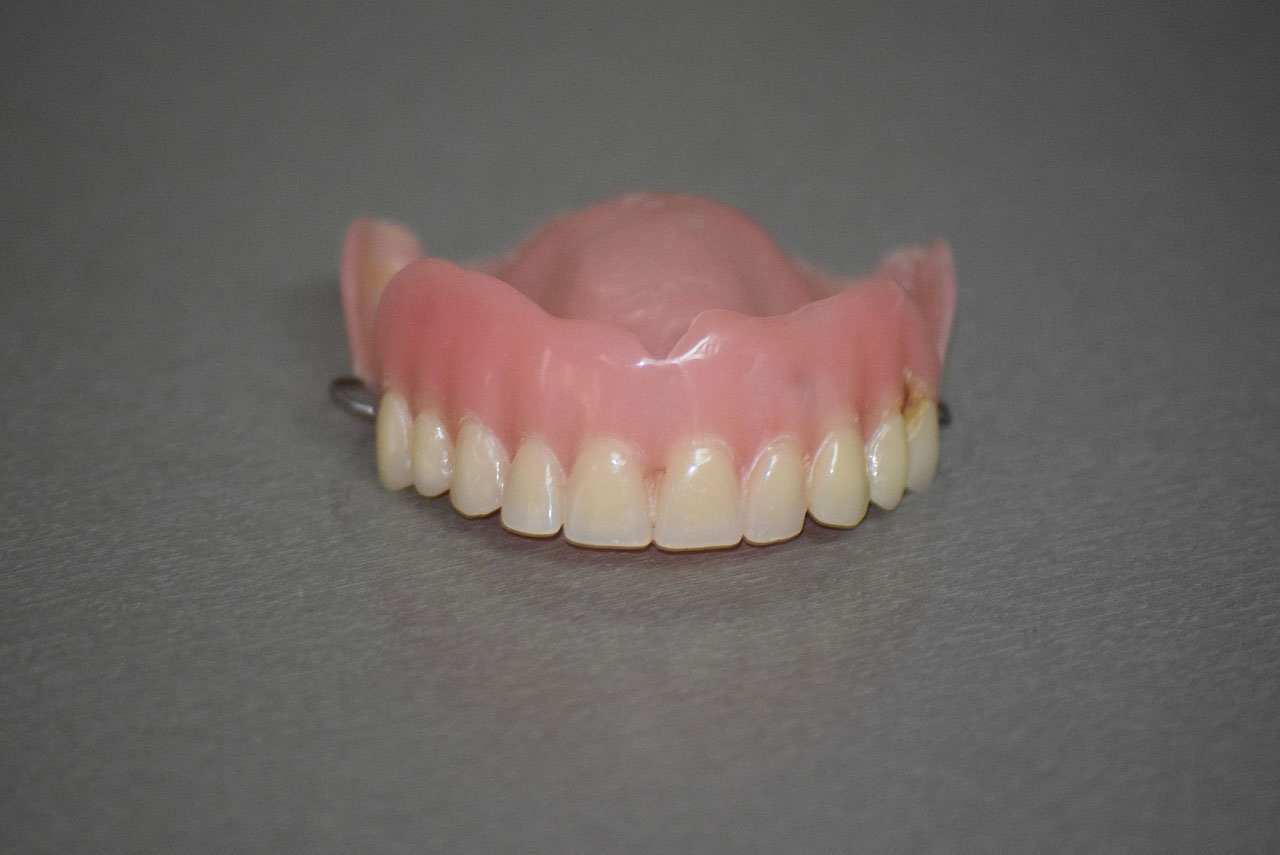
The complete denture
Commonly called dentures, this prosthesis replaces all the upper or lower teeth.
Because it is removable, it is easier to clean.
It is designed to look like natural teeth, including a reproduction of healthy-looking gums.
Benefits of dental implants
The main benefits of dental implants are:
- Strengthening the supporting bone, which weakens with age
- Greater comfort when chewing
- An attractive appearance
- Better chewing, contributing to better digestion
Here are some useful links on this topic:
https://www.maboucheensante.com/article/ponts-protheses-implants-dentaires/
http://www.cda-adc.ca/fr/oral_health/talk/procedures/dental_implants/